The development of an oil or gas reservoir typically follows several stages, including exploration, appraisal, well drilling, completion, stimulation, and production. Hydraulic fracturing is part of the well stimulation stage, which occurs after a well has been drilled and completed, but before production begins.
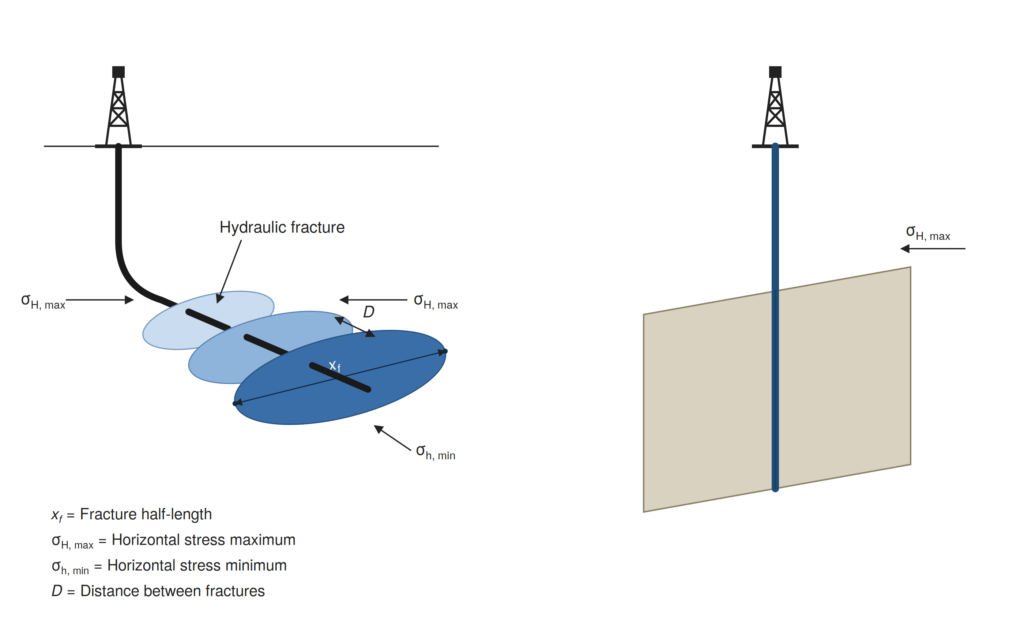
Figure 1.4.1: Fracture geometry for a multi-fractured horizontal well (left) and a single-fracture vertical well (right)
Once a reservoir has been discovered and evaluated, wells are drilled to access the hydrocarbon-bearing formation. However, drilling a well alone does not always guarantee economically viable production. Many reservoirs, especially those with low permeability, do not allow hydrocarbons to flow easily toward the wellbore. In such cases, additional treatments are needed to improve the connection between the well and the reservoir.
Hydraulic fracturing is utilized during the well completion and stimulation phase to enhance this connection. During a fracturing treatment, fluid is injected into the formation at pressures high enough to create fractures in the rock. These fractures extend away from the wellbore and are typically kept open with solid particles called proppants, which help maintain conductive pathways for fluid flow after the pumping ceases.
Creating artificial flow pathways through hydraulic fracturing expands the effective drainage area and improves production rates. In high permeability conventional reservoirs, fracturing helps bypass near-wellbore damage, reduces near-wellbore pressure drawdown, and increases productivity to balance out flow restrictions in wells requiring gravel packs (aka fracpacks). In low permeablity conventional reservoirs, fracturing is typically applied for vertical wellbores to increase productivity. For unconventional reservoirs that have ultra-low permeabilty, like shales and tight sandstones and carbonates, multiple hydraulic fractures from long horizontal wellbore is essential for economic operation. Wells may often include 50 stages or more along a 10,000+ ft lateral to maximize wellbore surface area, and spacing between multi-frac laterals is an intergral design element to prevent frac hits and undue flow interference for adjacent wells.1Economides, M. J., & Nolte, K. G. (2000). Reservoir stimulation (Vol. 18). New York: Wiley.