Course Navigation
Course Home Expand All

Birth of Fracture Mechanics

1. The Birth of Fracture Mechanics

Fractures are a form of failure in solid material. Rock is the material of interest for hydraulic fracturing, but much of the theory used to analyze rock failure comes from work done on engineered materials like metals that are used to build ships and airplanes. Interestingly, the birth of fracture mechanics was motivated by the failure of Liberty ships built in the US in the 1940's to support Europe during World War II1Liberty ship. (2026, June 16). In Wikipedia. https://en.wikipedia.org/wiki/Liberty_ship#Problems. New welding techniques were developed to join the fabricated steel plates that make up the hull of the ship because welding allowed faster manufacture than the previous riveting methods. Unfortunately, these new welding techniques, combined with other factors such as steel shrinkage in response to the unusually cold waters of the North Sea, promoted crack propagation, and many ships literally split in two and sank. Intensive theoretical and experimental studies were undertaken to solve the serious problem of ships sinking without warning, and this was the birth of the discipline of fracture mechanics.

Figure 3.1.1: The Liberty Ship Schenectady broke amidships on a still, cold winter night in harbor in Portland, OR. At the time, the failure was attributed to poor welding procedures, which were later connected with uncontrolled crack propagation.2[Photograph of the tanker SS Schenectady broken in two]. (1943). Wikimedia Commons. https://commons.wikimedia.org/wiki/File:TankerSchenectady.jpg

2. Basic Fracture Propagation Principles

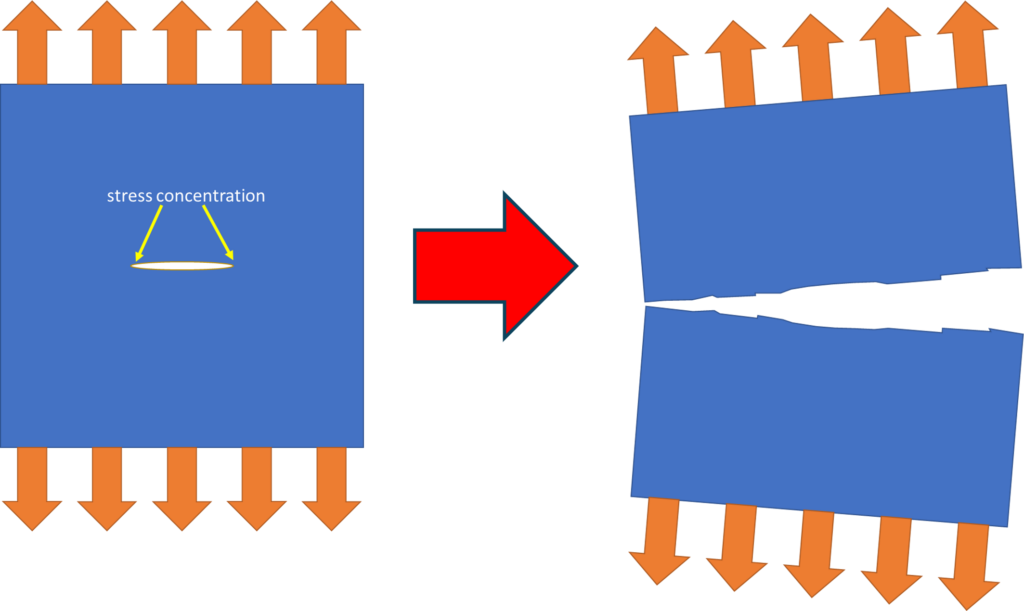
The advancement of fracture mechanics over previous mechanics analysis techniques was its ability to predict the initiation, propagation and arrest of a fracture in a solid material. Fracture mechanics is premised on the idea that all materials contain flaws, and those flaws are often in the shape of microscopic tabular voids called microcracks. The importance of flaws being cracklike in nature is they have sharp tips that concentrate the stresses in a material above the ambient applied load. This precipitates early failure in the form of crack propagation, from the flaw tips, that can cause a plate in tension to break into pieces.

Figure 3.1.2: A plate with an embedded crack loaded in uniaxial tension. When the fracture strength of the material is exceeded at the crack tip, the crack will propagate. If the applied tension is constant as the crack propagates, the sample will break in two.

3. Linear Elastic Fracture Mechanics

Linear Elastic Fracture Mechanics (LEFM) was developed to analyze and predict the brittle behavior of materials with flaws or macroscopic cracks. It was found that crack growth occurs when the stress concentration at the crack tip exceeds the inherent bond strength holding particles together within the material. The stress concentration at the crack tip is quantified with a parameter called the stress intensity factor, \( K_I \), which is calculated for a plate with a crack having a half-length \( c \) which is oriented perpendicular to the external tensile loading \( P \) (Figure 3.1.2) as

\[ K_I = P\sqrt{\pi c} \tag{3.1} \]

When \( K_I \) exceeds the fracture toughness, \( K_{Ic} \), the crack will propagate. If the loading is continuously applied during, the crack will propagate all the way across the plate causing complete failure. The "I" in the parameters defined above indicates what is called mode I or opening mode fracture, which is the result of tensile loading at the tip. Shear loading is denoted as mode II or III, which we will not discuss in detail here.

Deeper Dive: Example Calculation

A steel plate has a fracture toughness of \( 1\ \text{MPa}\sqrt{\text{m}} \) and contains a very small flaw whose half-length is 0.001 meters (approximately 0.04 inches). What stress is required to cause this crack to propagate?

Answer:

Failure occurs when \( K_I \) exceeds the fracture toughness, \( K_{Ic} \), so incipient failure occurs when \( K_I = K_{Ic} \). Substituting that condition into equation 3.1 gives

\[ K_I = K_{Ic} = P\sqrt{\pi c} \]

Solving this equation for the load at failure, \( P \), and inserting the given values for \( K_{Ic} \) and \( c \), gives

\[ P = \frac{K_{Ic}}{\sqrt{\pi c}} = \frac{1\ \text{MPa}\sqrt{\text{m}}}{\sqrt{3.14 \times 0.001\ \text{m}}} = 18\ \text{MPa}\ \ (\text{equivalent to approximately 2,600 psi}) \]

If the plate had a serious flaw with a half-length of 0.05m (approximately 2 inches), the stress required for propagation would be only

\[ P = \frac{1\ \text{MPa}\sqrt{\text{m}}}{\sqrt{3.14 \times 0.05\ \text{m}}} = 2.5\ \text{MPa}\ \ (\text{equivalent to approximately 360 psi}) \]

This calculation shows that the stress at which a cracked material will fail is flaw size dependent. The solution above shows that the stress required for failure decreases as \( 1/\sqrt{c} \). This also implies that once a crack starts to grow, the stress required to keep it propagating will decrease. Since the stress to propagate a crack goes down as the crack gets longer, the fracture process is inherently unstable.