Radial Flow Injection
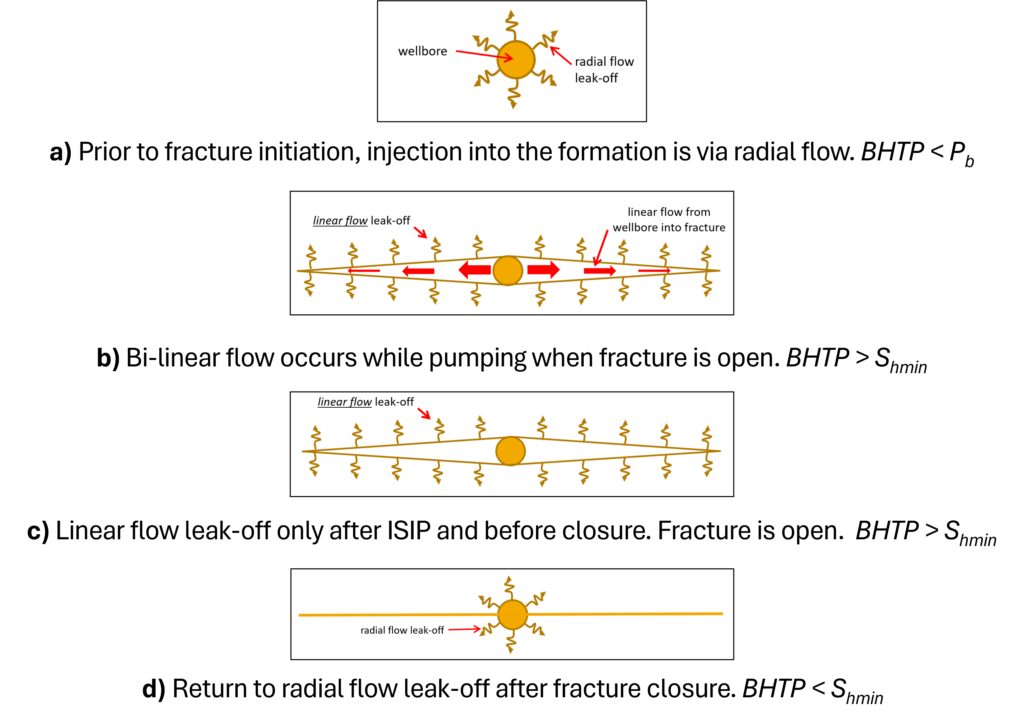
Before fracture initiation, the injected fluid enters the formation through
radial flow from the wellbore. Because hydraulic fracturing is performed at a
constant injection rate that exceeds the formation's ability to accept fluid by
radial flow alone, the bottomhole treating pressure (BHTP) rises rapidly. When
the BHTP exceeds the breakdown pressure (Pb), the
rock fails and a hydraulic fracture is created. The breakdown pressure is
typically identified as the highest pressure reached at the beginning of the
injection, marking the transition from radial flow into fracture propagation.
Bi-Linear Flow Injection
Once the fracture has initiated, the injected fluid flows from the wellbore into
the fracture while simultaneously leaking off from both fracture faces into the
surrounding formation. This creates a bi-linear flow regime, consisting of linear
flow within the fracture and linear leak-off perpendicular to the fracture
surfaces. During this stage, the fracture remains open and continues to
propagate. The pressure required to maintain fracture growth is called the
fracture propagation pressure, which is generally lower than the breakdown
pressure because the fracture has already been created.
The fracture propagation pressure depends on several factors, including:
- In-situ stresses
- Fluid viscosity
- Fluid leak-off into the formation
- Fracture geometry
- Injection rate
Linear Leak-off Before Fracture Closure
After the desired volume of fracturing fluid has been injected, the pumps are
shut down and the well is shut in. The instantaneous shut-in pressure (ISIP) is
measured immediately after pumping stops, once the effects of wellbore friction
have dissipated. At this stage, the fracture is still open, and fluid continues
to leak off from the fracture faces into the surrounding formation.
During this period, the pressure decline is primarily controlled by linear
leak-off from the fracture into the formation. This linear-flow regime persists
only while the fracture remains open. As leak-off continues, the fracture
gradually loses width until it eventually closes.
Radial Flow After Fracture Closure
When the fracture closes, it no longer provides an open flow path into the
formation. Consequently, the flow regime transitions from linear leak-off to
radial flow around the wellbore. The pressure corresponding to this transition is
interpreted as the fracture closure pressure, which is commonly used as an
estimate of the minimum horizontal stress (Shmin) in
the formation.
Fracture closure is therefore identified by recognizing the transition in the
pressure response from linear leak-off while the fracture is open to radial flow
after the fracture has closed.