Unconfined Conditions in the Laboratory
One of the unique aspects of creating fractures in rock is that all of the stresses in the earth are compressive. The video below shows how a rock fails under uniaxial compression in what is called an unconfined compressive test. Unconfined means there is no lateral support to the sample when it is compressed vertically. The applied stress from the testing machine is compressive, applied to the ends of the sample, but internally the rock experiences both tension and shear due to stress concentration on existing flaws and at grain to grain contacts.
Figure 3.2.1: Sandstone samples of 1 inch diameter (stacked on top of each other to make a longer sample) loaded in a uniaxial compression load frame. Samples are loaded in vertical compression until failure, which in this experiment occurred at 5,000 lbs, which for a 1 inch diameter sample corresponds to approximately 6,350 psi (lbs/in2).
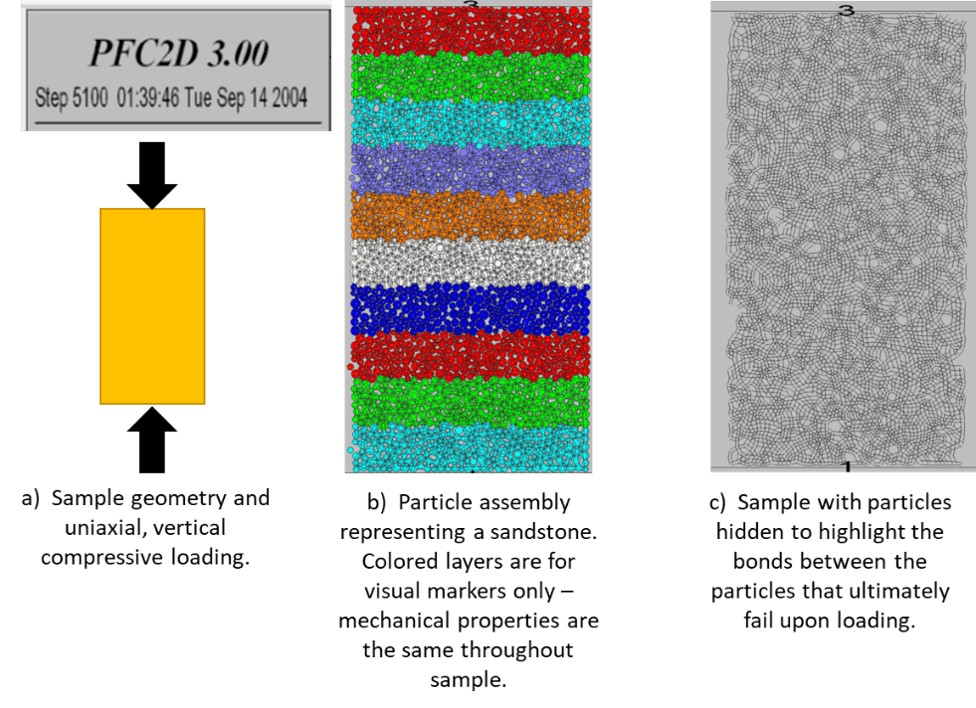
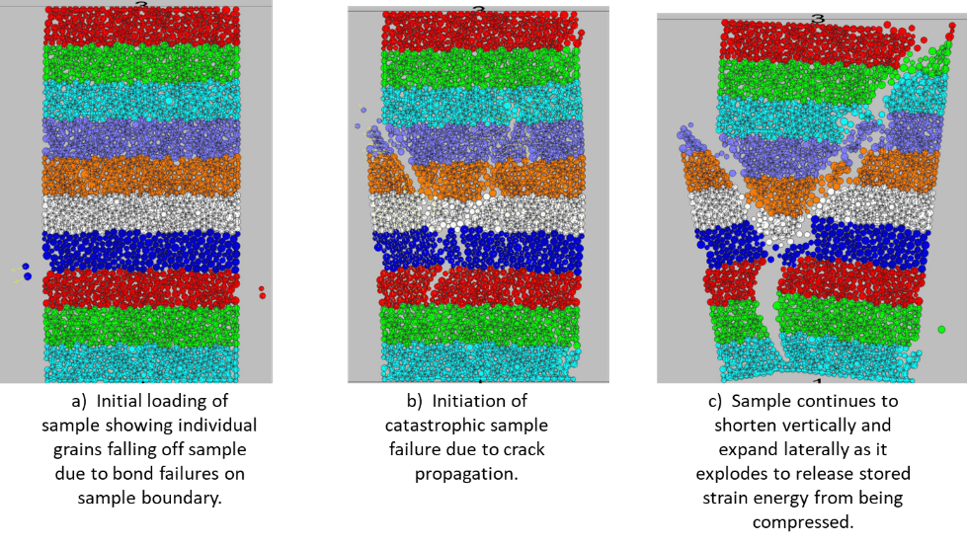
Figures 3.2.2 and 3.2.3 depict a numerical simulation that shows the progressive failure of a granular sample analogous to the sandstone failure video in Figure 3.2.1. The code used to generate this simulation is called PFC2D, licensed by Itasca Software. A sandstone is represented in the model as a collection of grains that are bonded together with cement (Figure 3.2.2). Upon loading, the sample shortens vertically and expands laterally during pre-failure, elastic deformation. When the strength of the bonds is exceeded, they break and the grains are no longer constrained. Progressive bond breakage links together to propagate cracks in the sample. Once failure begins, crack propagation throughout the sample causes it to literally explode, releasing the mechanical energy it had stored while being compressed and shortened pre-failure.
Figure 3.2.2: Loading and sample geometry for unconfined compressive test simulation using numerical model PFC2D.
Figure 3.2.3: Progressive deformation in an unconfined compressive test modeled with PFC2D.
The difference between the unconfined compressive test in the laboratory and failure of rock in the subsurface is that the rock in the subsurface is confined laterally, so it cannot freely expand (or explode) in response to loading. Brittle failure in the subsurface still involves crack propagation, but it typically consists of more controlled development of shear displacement along a fault or progressive opening displacement in effective tension (fluid pressure that is higher than the overall rock compression) for natural or induced hydraulic fractures. Fault slip during an earthquake is an exception to the idea of slow strain deformation as the generation of seismic (earthquake) waves implies shear displacement in the order of centimeters to meters occurred in seconds or faster. But even earthquakes are typically not an instantaneous explosive deformation like the unconfined compressive test.