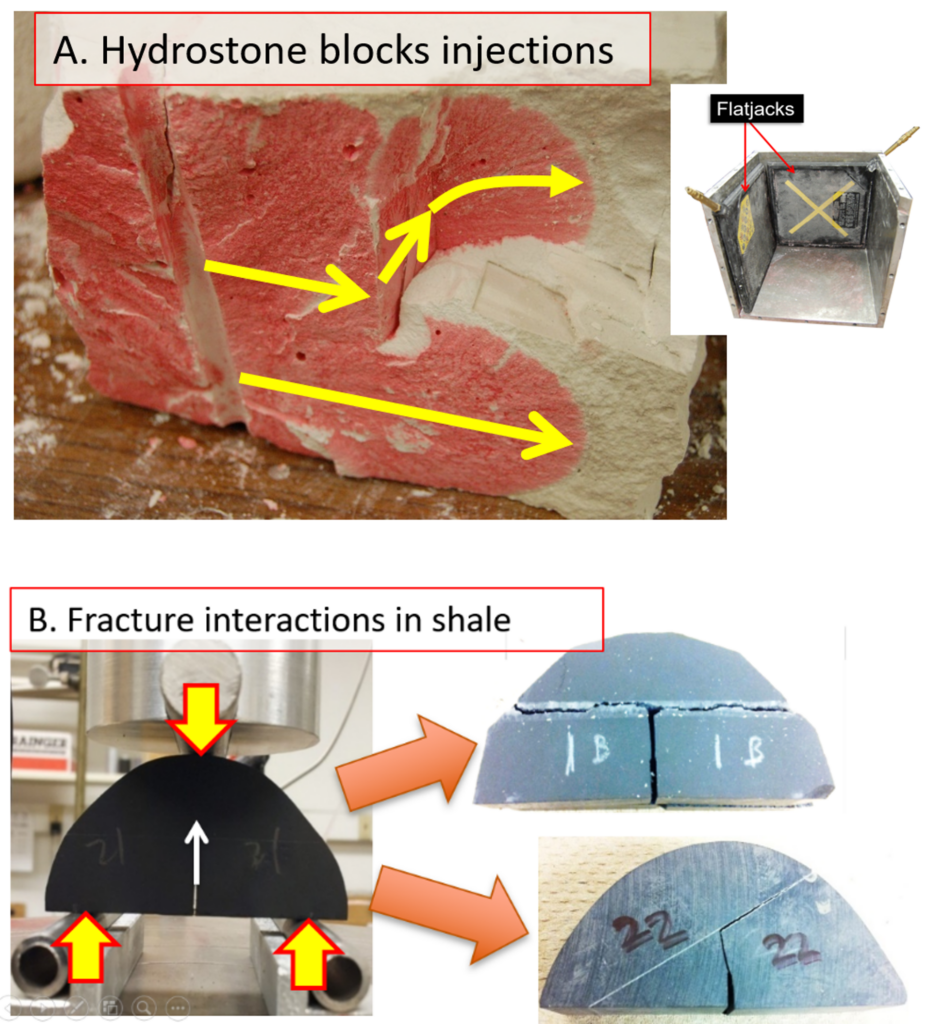
Figure 3.7.1: Fracture complexity developed in laboratory experiments. A) Cubic foot hydrostone experiments with injected hydraulic fracture (red dye) bifurcating at pre-existing planar inclusion mimicking cemented natural fracture1Bahorich, B., Olson, J. E., & Holder, J. (2012, October 8–10). Examining the effect of cemented natural fractures on hydraulic fracture propagation in hydrostone block experiments [Paper presentation]. SPE Annual Technical Conference and Exhibition, San Antonio, TX, United States. https://doi.org/10.2118/160197-MS. B) Tensile crack propagation in subsurface Marcellus core samples showing crack diversion by calcite cemented veins with orthogonal and oblique approach angles2Lee, H. P., Olson, J. E., Holder, J., Gale, J. F. W., & Myers, R. D. (2015). The interaction of propagating opening mode fractures with preexisting discontinuities in shale. Journal of Geophysical Research: Solid Earth, 120(1), 169–181. https://doi.org/10.1002/2014JB011358.