Oil and gas reservoirs are usually categorized as conventional or unconventional based on the characteristics of the reservoir rock and the techniques needed to extract hydrocarbons.
Conventional Reservoirs
In conventional reservoirs, hydrocarbons migrate from a source rock into a porous and permeable reservoir rock such as sandstone or carbonate. These rocks typically have sufficient permeability to produce oil or gas at economic rates from vertical or deviated wellbores. As a result, hydrocarbons can often be produced with relatively simple well designs and without extensive stimulation treatments. Although stimulation techniques may still be used to enhance productivity, production in conventional reservoirs is primarily controlled by the reservoir rock’s natural properties.1Ahmed, U., & Meehan, D. N. (Eds.). (2016). Unconventional oil and gas resources: exploitation and development. CRC Press.
Unconventional Reservoirs
In contrast, unconventional reservoirs are what is normally considered a source rock – for instance, hydrocarbon rich shales and calcareous mudstones. These formations have permeabilities that are many orders of magnitude less than conventional reservoir rocks. Other examples of unconventional resources include tight oil and gas formations and coalbed methane reservoirs.1Ahmed, U., & Meehan, D. N. (Eds.). (2016). Unconventional oil and gas resources: exploitation and development. CRC Press.
Because of their low-permeability conditions, unconventional reservoirs typically need specialized drilling and completion techniques to achieve economic production. Technologies like hydraulic fracturing and horizontal drilling are commonly used to create additional pathways for fluid flow and to expand the contact area between the wellbore and the reservoir.1Ahmed, U., & Meehan, D. N. (Eds.). (2016). Unconventional oil and gas resources: exploitation and development. CRC Press.
Although the distinction between conventional and unconventional reservoirs is often described qualitatively, it can be defined more precisely using just two parameters: the viscosity of the reservoir fluid and the permeability of the reservoir rock. Conventional reservoirs combine low fluid viscosity with sufficient rock permeability, so hydrocarbons can flow to the wellbore at economic rates without extensive intervention. A reservoir becomes unconventional when either of these conditions fails: when the fluid is too viscous to flow readily (as in heavy oil deposits and oil shales), or when the rock permeability is too low for the fluid to move through it (as in tight gas, shale oil, and shale gas formations).
Figure 1.2.1 illustrates this classification on a plot of viscosity versus permeability. The dashed line separates the conventional region — low viscosity fluids in rocks with permeabilities of roughly 0.1 md and above — from the unconventional region, which spans everything from shale dry gas at nanodarcy permeabilities to highly viscous oil shales. Note that this definition is based entirely on the properties of the rock and the fluid, not on how the well is drilled or completed: horizontal drilling and hydraulic fracturing are techniques frequently applied to unconventional reservoirs, but it is the reservoir itself that carries the classification.2Cander, H. (2012). PS what are unconventional resources? A simple definition using viscosity and permeability. In AAPG Annual Convention and Exhibition. Tulsa, US: American Association of Petroleum Geologists and Society for Sedimentary Geology.
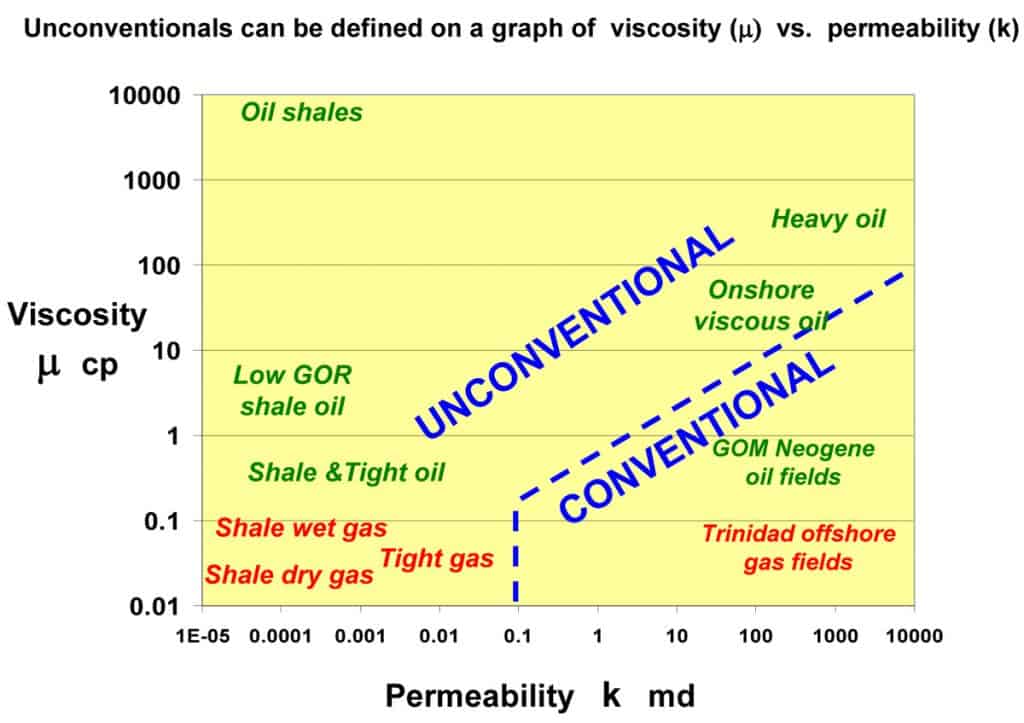
Figure 1.2.1: Classification of conventional and unconventional resources on a plot of fluid viscosity versus reservoir permeability.2Cander, H. (2012). PS what are unconventional resources? A simple definition using viscosity and permeability. In AAPG Annual Convention and Exhibition. Tulsa, US: American Association of Petroleum Geologists and Society for Sedimentary Geology.