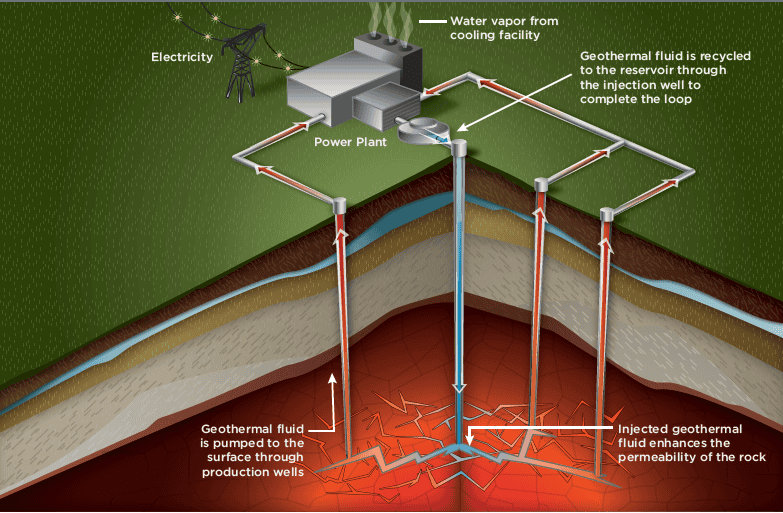
Enhanced Geothermal Systems (EGS) are engineered reservoirs designed to extract heat from subsurface rock formations that are naturally hot but lack sufficient permeability or fluid for conventional geothermal production. Unlike naturally occurring hydrothermal systems, which rely on existing heat, fluid, and permeability, EGS creates these conditions artificially by injecting fluid into the subsurface to stimulate the rock and enhance its permeability.
The process begins by identifying a suitable site with high temperatures at depth. Wells are then drilled into the hot rock, and water is injected at elevated pressures to reopen pre-existing fractures or create new ones. This stimulation process forms a connected fracture network that allows fluid to circulate through the reservoir. As the injected fluid moves through the fractured rock, it absorbs heat and is then produced back to the surface through a production well.
At the surface, the heated fluid is used to generate electricity, either directly as steam or indirectly via heat-exchange systems. The fluid is then reinjected into the reservoir, creating a closed-loop system that allows continuous heat extraction. This circulation loop is a key feature of EGS, enabling long-term and sustainable energy production.
One important aspect of EGS is the occurrence of microseismic events during reservoir stimulation. These small-scale seismic signals result from the movement along fractures and are typically too weak to be felt at the surface. However, they provide valuable information about fracture growth and reservoir extent, making them an important diagnostic tool for monitoring and optimizing the system.
EGS has significant potential as a clean and reliable energy source. Because it does not depend on naturally permeable reservoirs, it can expand geothermal energy production beyond traditional locations. In addition, EGS systems can provide continuous baseload power with minimal greenhouse gas emissions, making them an important component of future energy systems.