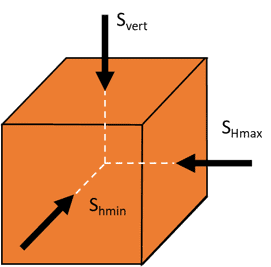
The vertical stress is the overburden weight at any given depth,
which is a function of the average bulk density of the rock. It can be calculated
as
\[ S_{vert} = \bar{\rho}_b \cdot g \cdot z \tag{3.2} \]
where
- \( \bar{\rho}_b \) is the average bulk density of the rock to a given depth, \( z \), where bulk density includes both the grains and fluids that make up the rock,
- \( g \) is the gravitational constant,
- and \( z \) is the depth.
Accurate measurement of the in-situ stress field is essential for fracture
design. Vertical stress is readily computed based on the density log, but
determination of the horizontal stresses is more challenging. One commonly used
method to measure Shmin at a particular depth is the
Diagnostic Fracture Injection Test (DFIT), which analyzes pressure behavior
during a controlled fluid injection that creates a hydraulic fracture. Log-based
methods for stress characterization can predict the layer by layer stress
characteristics that influence fracture height growth or
containment.
Common In Situ Stress Gradients Magnitudes
It is recommended to make site specific measurements of in situ stresses for the
sake of accuracy, but in most regions, it is safe to assume that the vertical
stress, Svert, has a gradient of 1 psi/ft. The
minimum horizontal stress, Shmin, can have a wide
range. For normal and strike-slip faulting stress regimes,
Shmin is expected to fall between 0.5 and 1.0 psi/ft.
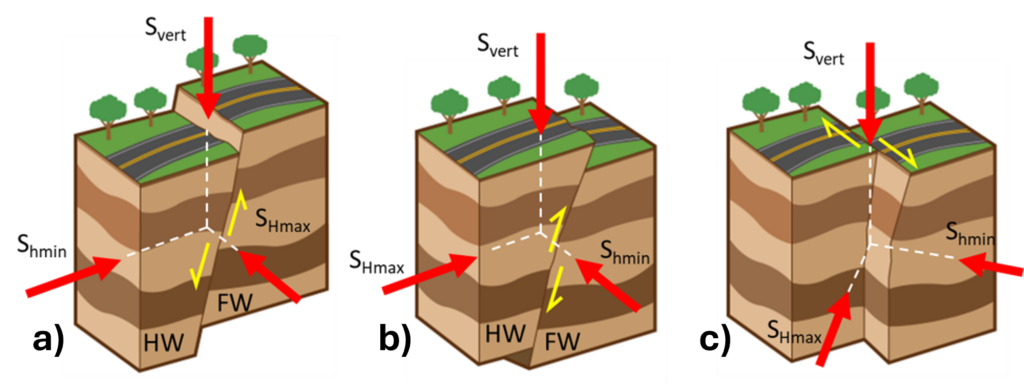
SHmax is the most difficult stress to constrain
without downhole measurements, so no expected range will be offered here beyond
the expected relative magnitudes specified in the caption of
Figure 3.4.2.