In the previous topic, the performance of a well was examined through the lens of the idealized steady state, radial flow equation. It was shown that reservoir permeability can determine whether a well is economic or not. If permeability is too low, the flow rate may not be high enough to generate the income to pay for the well and support profitable continuing operations. However, if the original oil in place is sufficiently large, stimulation methods can be undertaken to enhance the flow to reach economic rates. One way to quantify the effectiveness of such operations is to use a mathematical concept developed for radial flow wells called the skin factor1Van Everdingen, A. F. (1953). The skin effect and its influence on the productive capacity of a well. Journal of Petroleum Technology, 5(06), 171-176. doi: https://doi.org/10.2118/203-G2Hurst, W. (1953). The establishment of the skin effect and its impediment to fluid flow into a well bore. Petroleum Engineer, 25(11), B6–B16 , which can be included in our idealized steady-state inflow, equation 2.1, as follows:
where \(s\) is the skin factor. After stimulation, the most common methods of which are hydraulic fracturing and matrix acidizing, it is possible to reach a negative skin (\(s < 0\)), which increases the production rate by reducing the magnitude of the expression \((\ln(r_e / r_w) + s)\) in equation 2.2.
Although the skin effect is a convenient tool to evaluate stimulation effectiveness, it was originally developed to quantify near wellbore permeability reduction caused by the invasion of drilling mud solids (i.e., clay particles) into the reservoir. These mud invasion effects are commonly referred to as formation damage. The impact of such near-wellbore alterations on well performance can also be represented mathematically with the skin factor, but damage results in positive skin (\(s > 0\)).
A summary of how the skin factor affects calculated flow rate follows:
- Positive skin (\(s > 0\)): indicates additional resistance to flow near the wellbore. This usually results from formation damage and reduces production rates.
- Zero skin (\(s = 0\)): represents an ideal well with no additional flow resistance beyond that predicted by radial flow theory.
- Negative skin (\(s < 0\)): indicates improved flow conditions near the wellbore beyond the formation’s original properties. This occurs when stimulation treatments increase the conductivity of the region surrounding the well.
Skin factor is typically quantified in the field by running a pressure transient test, which is a short term flow test where both rate and pressure are quantified under prescribed boundary conditions. Once skin factor is determined, its effect on flow rate can be quantified using an expression called the productivity index ratio, \(J/J_o\), which is the ratio of the productivity index of the damaged or stimulated well, \(J\), to the reference case of a zero skin well, \(J_o\). The productivity index, \(J\), is defined as
This factor quantifies the deliverability of a well as a function of drawdown. The better wells are those that can deliver the most rate with the least drawdown, which usually corresponds to wells that can produce the most oil for the longest time.
Based on equation 2.2, the productivity index ratio can be determined as
An undamaged well without any stimulation will have a zero skin and \(J/J_o = 1\). A damaged well will have a positive skin (\(s > 0\)) and a productivity index ratio less than 1 (\(J/J_o < 1\)). A stimulated well will have a negative skin (\(s < 0\)) and a productivity index ratio greater than 1 (\(J/J_o > 1\)).
Matrix stimulation methods, such as injecting acid, remove formation damage and restore permeability near the well. For rocks with a high acid solubility, the permeability in the stimulated region may even exceed the original reservoir permeability, which is when the skin factor can go negative. Hydraulic fracturing bypasses the near wellbore damage zone, negating its negative effects, and then increases flow beyond the capability of a zero skin well by increasing wellbore surface area and removing the negative flow convergence effects caused by radial flow.
Example of Skin Factor Impact on flow rate
Using example data from the previous topic (\(r_e = 745\) ft, \(r_w = 0.25\) ft, \(\ln(r_e / r_w) = 8.0\)), we can plot the impact of skin factor on production rate relative to the undamaged/unstimulated well (Figure 2.2.1). Mathematically, equation 2.4 would become undefined when \(s \leq -\ln(r_e / r_w)\), so that limits the possible range of skin factor.
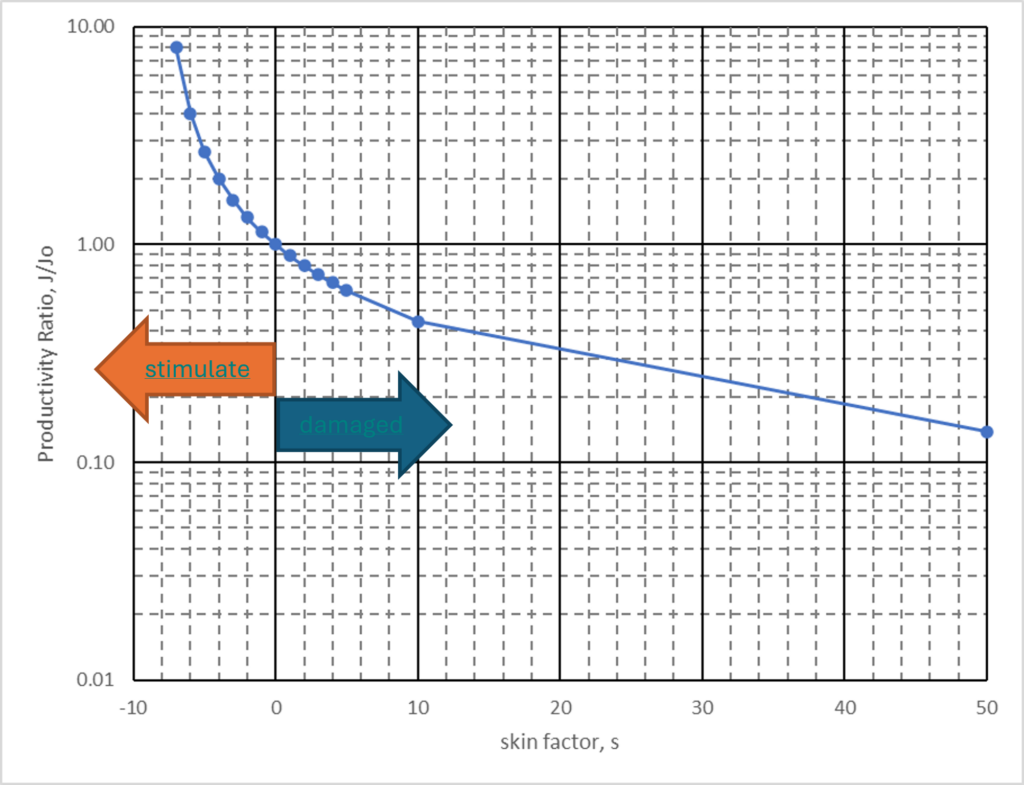
Based on the data plotted in Figure 2.2.1, skin damage can have a significant effect on wellbore productivity. A skin factor of 5, which represents a modest amount of near-wellbore damage, could reduce the productivity of a well by 40%. Severe damage cases could have skin factors of 50 (or more), which the figure indicates would reduce productivity by nearly 90%. A typical matrix stimulation done with acid should reduce the skin factor to 0, but for formations that are highly soluble to the acid used, negative skins of −3 to −5 can sometimes be achieved. Based on the figure, such negative skins could improve productivity by 1.5 to 3 times compared to an undamaged well. For high permeability conventional wells with undamaged production rates of hundreds or thousands of barrels per day, this magnitude rate multiplier would deliver a significant amount of incremental oil. However, for a low permeability well with single digit undamaged rate capability, the incremental oil from matrix acid stimulation (J/Jo of 1.5 to 3) would still be non-economic. These low rate unstimulated wells are candidates for hydraulic fracture stimulation, which can achieve higher J/Jo values. In the next topic, the potential for fracturing to produce productivity ratio improvements greater than possible with matrix stimulation will be explored.