Drilling Technology
Oil and gas wells can be categorized as vertical or horizontal based on the orientation of the wellbore within the reservoir (Figure 1.3.1). More generally, any non-vertical well is categorized as being deviated (from vertical), and a horizontal well represents the limit of the deviation angle range, 90 degrees. Advances in directional drilling technology were initially motivated to meet the needs of offshore development, where an entire field’s development was drilled from a single fixed platform location, and all of the wells needed to tie back to the same spot. Directional drilling from multi-well pads onshore was also developed for drilling in environmentally sensitive locations, such as jungles, the north slope of Alaska, and urban, intra-city locations.
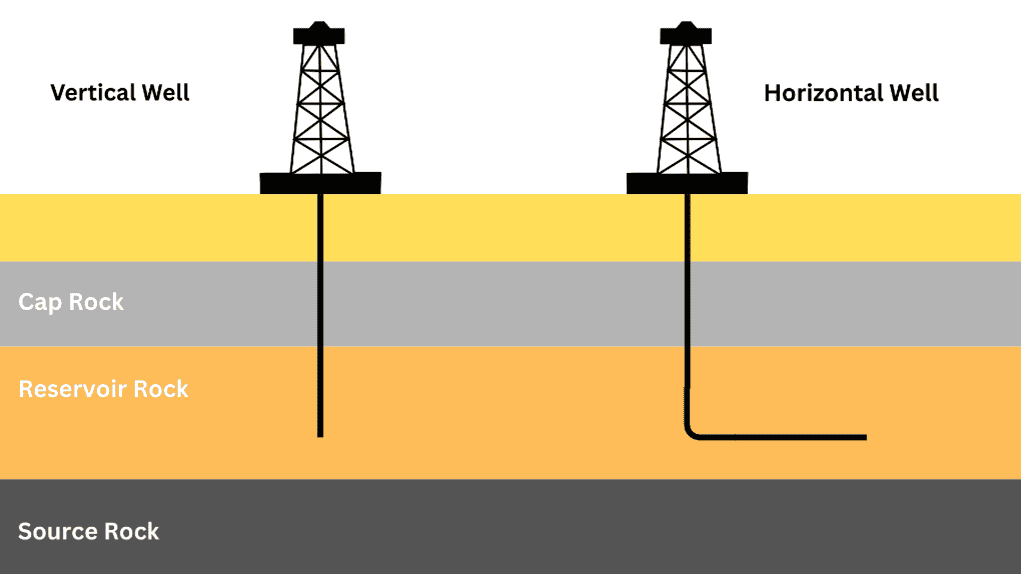
Figure 1.3.1: Vertical vs. Horizontal Wells
Even prior to the multi-frac horizontal shale well boom, drillers were pushing extended reach drilling ranges beyond the 10,000 ft mark. Major challenges to overcome were torque and drag limits as well as steering accuracy.
- For torque and drag, pushing and rotating the pipe becomes more difficult as a large proportion of the well’s measured depth (MD) is non-vertical because the pipe lies on the bottom of the hole and the pipe/formation friction resists movement.
- With regard to steering, challenges lay in knowing the location of the drill bit, the direction the drill bit is pointed, and how to change the direction of the drill bit in order to keep the wellbore in the target zone with reasonable accuracy.
In the 1990’s, BP famously accomplished an extended reach record of 33,000 ft measured depth (MD) at only 5,300 ft true vertical depth (TVD) in the Wytch Farm Development in Southern England. Wytch Farm at the time was the largest onshore development in Western Europe with over 500 million bbls of oil in-place. The drilling challenge BP was innovating to overcome was the lack of weight on bit (WOB) that can be achieved at limited TVD which diminishes the force pushings the drillstring against the high frictional load caused by the drillpipe lying on the bottom of the hole over an extended distance. These early drilling milestones paved the way for further innovation that has made mulit-mile laterals in unconventional reservoirs not only possible but economic.1 Allen, F., Tooms, P., Conran, G., Lesso, B., & Van de Slijke, P. (1997). Extended-reach drilling: breaking the 10-km barrier. Oilfield Review, 9(4), 32-47. Retrieved from https://www.slb.com/-/media/files/oilfield-review/ex-drilling
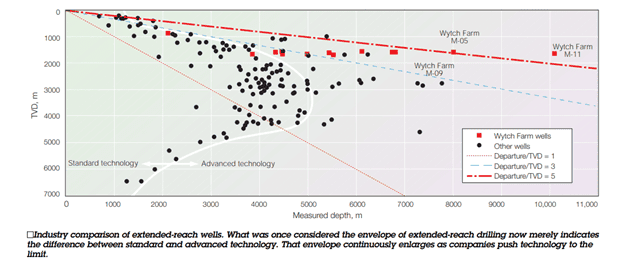
Figure 1.3.2: Advancing drilling capability in the 1990’s for extended reach wells laid the foundation for everyday horizontal drilling in the 2000’s for the shale boom. 1Allen, F., Tooms, P., Conran, G., Lesso, B., & Van de Slijke, P. (1997). Extended-reach drilling: breaking the 10-km barrier. Oilfield Review, 9(4), 32-47. Retrieved from https://www.slb.com/-/media/files/oilfield-review/ex-drilling
Wellbore Geometry as a Constraint on Flow Capacity: Conventional vs Unconventional Reservoirs
Traditional conventional wells are drilled vertically, contacting only a limited thickness of the reservoir, typically tens to hundreds of feet. As a result, the area through which hydrocarbons can flow into the well is relatively small. However, in high permeability reservoirs, this is not an obstacle to economic field development. On the other hand, if a vertical well is uneconomic because of limited permeability, an operator might stimulate the well, and hydraulic fracturing is the ultimate stimulation method. The primary benefits of fracturing a vertical well are two-fold: the flow geometry to the wellbore is altered from radial flow to more effieicnt linear flow, and the surface area of the wellbore is significantly increased.
- With regard to flow geometry, in radial flow with a vertical wellbore, the flowlines around the wellbore are like spokes on a wheel, and hydrocarbon molecules are crowded and compressed as they converge on the wellbore, causing increased pressure drop that diminishes flow. With a hydraulic fracture as a part of the well, the flowlines are transformed into parallel lines perpendicular to the fracture plane (there is no more convergence of flow), and the hydrocarbon molecules are able to approach the fracture without having to compete for space with their neighbors, enhancing flow compared to the radial case.
- When examining contact area to flow, a fracture significantly enhances the surface area of the wellbore. For a ½ ft diameter (D) vertical well fully penetrating a 250 ft thick reservoir (H), the wellbore surface area would be 1,600 ft2 (A=pi*D*H). A typical hydraulic fracture height might be the thickness of the reservoir (250 ft in this case) and up to 2,000 ft in total length (L). The fracture has 2 sides that take in flow, so the total surface area is on the order of a million square ft (A=2*H*L). This kind of stimulation can extend economic hydrocarbon development using vertical wells into permeabilities on the order of the tenths of millidarcies or smaller for oil wells.
In unconventional reservoirs, horizontal wells are standard, affording much more contact length with the reservoir than vertical wells, on the order of miles (Figure 1.3.1). Although a horizontal wellbore has much more contact area with the formation than a vertical wellbore, miles instead of 100’s of feet, a horizontal wellbore’s stimulation effect is not competitive with even just one fracture from a vertical wellbore. The major breakthrough for unconventionals was pairing horizontal wells with hydraulic fracturing, first proven during the development of the Barnett Shale in Texas. The horizontal wellbore provides the initiation points for many hydraulic fractures all attached to a single flow conduit that only costs slightly more to drill than a vertical well.
The Power of Using Horizontal Wells with Multiple Hydraulic Fractures
A quick surface area calculation demonstrates the power of this wellbore/fracture geometry. As mentioned earlier, a typical hydraulic fracture alone might have a million square feet of surface area. Along a mile-long horizontal well, the fracture spacing might be 50 ft, meaning the well could have 100 fractures or more, resulting in a total surface area of 100 million square feet. This provides as much as 10,000 times more surface area to flow than an unfractured vertical well, or 100 times more than a fractured vertical well. Production data from the Barnett Shale (available online from the Texas Railroad Commission, www.trrc.gov) shows the impact of these numbers on real production results. A multi-frac horizontal well drilled in the Barnet in 2011 (Figure 1.3.3, Brown 2H well) produced 2 Bcf in only 6 months, whereas a single frac vertical well from 1996 (Rudd, WL #8-A) took 170 months to produce the same amount. These kind of productivity enhancements, enabled by multi-frac horizontal well technology, are what created an oil and gas boom that propelled the United States to production levels unrivalled even by the most prolific Middle East oil producing countries.
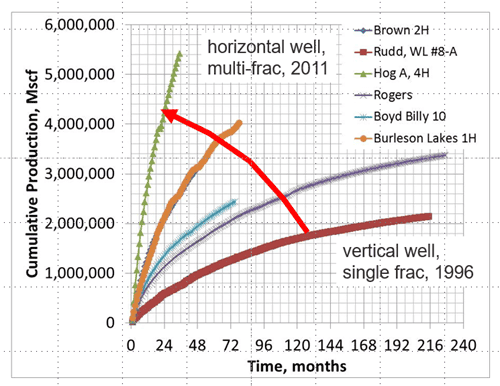
Figure 1.3.3: Cumulative gas production for various Barnett Shale wells in the Forth Worth Basin, demonstrating the advantage of multifracture horizontal wells over single fracture vertical wells. Time is synced so that all wells first month is zeroed to the same location on the time axis for comparison purposes