Rheology is the study of the deformation and flow of matter. In hydraulic fracturing, rheology is important because it determines how the fracturing fluid behaves under different conditions of shear rate, temperature, and time. These properties strongly influence friction pressure, proppant transport, and fluid performance in the wellbore and fracture.
In laminar flow, shear rate is defined as the velocity difference between two adjacent fluid layers divided by the distance between them:
The shear stress is the shearing force per unit area:
The apparent viscosity is then defined as:
Newtonian fluids have constant viscosity at all shear rates, but most fracturing fluids are non-Newtonian, meaning their apparent viscosity changes with shear rate. Many fracturing fluids exhibit power-law behavior, which can be written as:
Where:
- \(\boldsymbol{\tau}\): shear stress
- \(\boldsymbol{\dot{\gamma}}\): shear rate
- \(\boldsymbol{K}\): consistency index
- \(\boldsymbol{n}\): flow behavior index
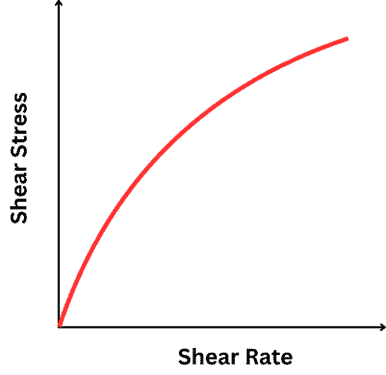
This model is widely used to represent fracturing-fluid behavior. In general, fracturing fluids experience high shear in tubing and perforations, but once inside the fracture, the shear rate decreases while the temperature increases toward formation conditions. Because of this, fluid properties measured in the laboratory must be interpreted carefully to ensure they reflect actual field conditions.
Crosslinked fluids are especially sensitive to shear history and temperature. During pumping, strong shear can reduce the final viscosity of a crosslinked gel if crosslinking occurs too early. For this reason, delayed crosslinking systems are often used so that the fluid develops higher viscosity inside the fracture rather than in the tubing.
Rheology also becomes more complex when proppant is added. Proppant-laden fluids generally have higher apparent viscosity and friction pressure than clean fluids, and their behavior depends on proppant concentration, particle size, and flow rate. Similarly, foam fracturing fluids have rheological properties that depend on foam quality, gas type, and liquid-phase composition.